If it catches fire, the whole neighborhood will go down in flames. That was the refrain of the citizenry of Dupont Circle upon the completion of the Cairo Hotel. That is why Washington has one of the only active and strictly enforced height limits in the entire world.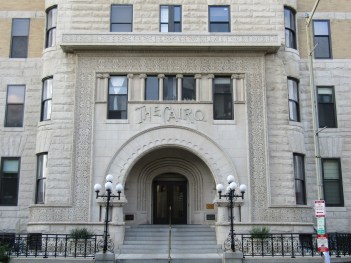
No, the height limit in DC was not drafted to preserve views of the capital building or the Washington Monument, though it is a happy side effect of that law. It was written to prevent developers from building skyscrapers that turn of the century Washingtonians worried were giant tinder boxes, posing a looming fire hazard over their homes.
It started with Thomas Schneider and the Cairo Hotel. And it started in Chicago, not DC.
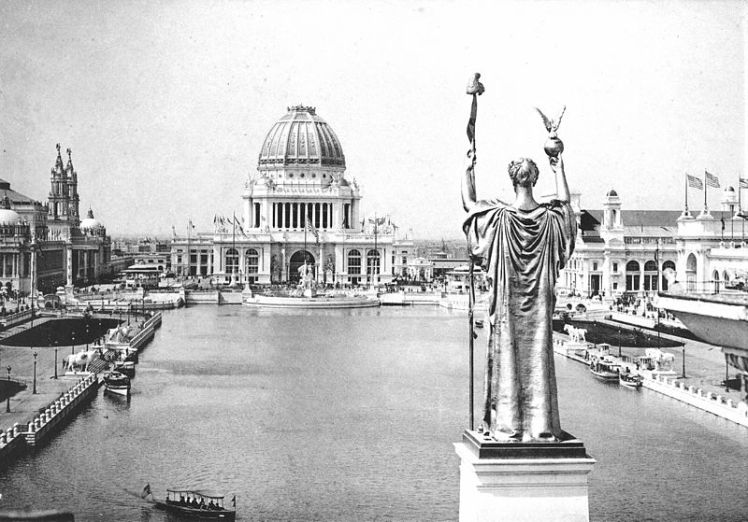
In 1893, an intrepid DC developer named Thomas Schneider, like many others, visited the Columbian Exposition in Chicago. Inspired by the 1889 Paris exposition, which gave the world the Eiffel Tower, Daniel Burnham, a renowned architect, developed Jackson Park into a stunning collection of sculptures and buildings, dubbed the “White City” due to white plaster that coated the buildings. At night, the White City was illuminated by Edison’s light bulbs, leading to one writer describing the event as “very likely the most beautiful thing ever created on the western hemisphere.”
The Washington Post described the Exposition as follows:
“For the first time America squarely challenges the older counties in every branch of human knowledge and activity…The stride of American art, as revealed in Chicago is stupendous, mysterious. Reaching out for a mile along the lake is an architectural vision of indescribable grandeur and beauty. It is not alone the individual character of the buildings but also the majestic and harmonious arrangement of the entire scene that reveals the pure and high artistic feeling animating the work- the relation of each building to the other in purpose, color, proportion, and outline, the variety of composition and the well nigh perfect unity of the whole.”
The Columbian Exposition, meant to commemorate the 400th anniversary of Columbus’s arrival in the new world, would inspire the City Beautiful movement in DC, and Schinder to build his own piece of American art as architecture, the Cairo Hotel on Q Street.
Built in 1894 and designed in the Moorish and Roman Revival styles, the Cairo Hotel stood at 164 feet, and dwarfed the surrounding neighborhood. Besides some detailing on the window sills, the Moorish revival style seems to be mostly reserved for the inside of the Cairo Hotel:
“Upon entering the original Cairo, the visitor found a large lobby, with an ornate public desk to the left and classical pillars surrounding a marble fountain in the center. The lobby extended into the rear courtyard, where it was lighted by an arched skylight. Adjacent to the lobby was a public parlor, called the Oriental Room, with Moorish and [British] Indian furnishings and detail. Other public spaces on the first floor included the office, reading room, ballroom, and drugstore. In the basement an artesian well supplied the Cairo with fresh water. Although most of the apartments contained decorative fireplace mantels with gas logs, only electricity was used for lighting, a unique feature for an apartment house of this period.”
Best Addresses by Goode (2003),
Though to say this is a shining beacon of Moorish revival architecture is disingenuous. There are no horseshoe arches or honeycombed half domes. It’s basically with a tall, steel framed, box with slight moorish embellishments.
Upon its completion, twenty five architects wrote scathing reviews, with the influential Architectural Review calling it a “box full of holes” and an “envelope of masonry”.
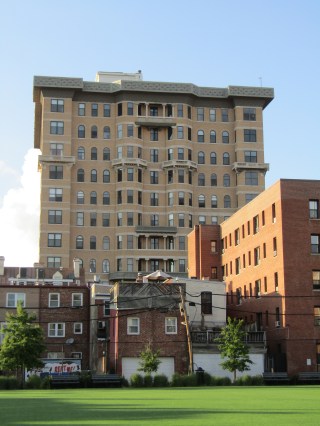
But it wasn’t the high minded debate on beauty that caused protests against the Cairo. It was about safety, specifically, fire safety. Residents of Dupont worried that the whole neighborhood could go down in flames if the hotel were to ever catch fire. These concerns became more timely after the “White City”, which served as Schneider’s inspiration, burned down the same year the Cairo went up.
A City Commissioner by the name of George Trusedell answered those worries and agreed that if there were to be a fire, no firetruck could send a stream of water high enough nor could any ladder reach the top floors, and urged the rest of the Board to adopt measures restricting the height of buildings in DC.
As a result of Trusedell’s recommendation, the height restriction of 1899 came into effect, essentially limiting residential buildings to 90 feet and commercial buildings to 110 feet.
For many urban planners, this was not nearly short enough.
In the grips of the City Beautiful movement, urban planners focused on how a height limit fostered civic beauty the the country’s capital. Secretary of the Board of Fine Arts Commision, Col. W. W. Harts said:
“Members of the fine arts commission are much exercised about the heights of buildings here, because they wish to prevent Washington from being ruined as so many of our cities are by skyscrapers. While the present building restrictions are good as far as they go, they do not go far enough.”
Washington Post, 1914
Col. Harts was not offering a unique or original view.
Since the founding of DC, limiting the height of buildings was of central importance. George Washington advocated for a height limit of 40 feet, and Thomas Jefferson, who can always be relied on for a quote, said:
“In Paris it is forbidden to build a house beyond a given height, and it is admitted to be a good restriction. It keeps down the price of ground, keeps the houses low and convenient, and the streets light and airy. Fires are much more manageable where houses are low.”
And while Jefferson famously envisioned Washington as an American Paris, perhaps in terms of Architecture, Rome and Athens are a more apt comparison. Athens and Rome are the only two major cities in Europe with height restrictions. Athens restricts buildings to twelve stories to preserve views of the Parthenon, and in Rome, no building can exceed the height of the dome of St. Peter’s Basilica within the Aurelian walls.
In North America, only Montreal and Madison, Wisconsin maintain height restrictions to preserve sightlines of architecture.
The debate on DC’s height limit never went away however, though the focus has shifted from fire safety to the balance of beauty and affordable housing.
Editorial pages are flooded with commentary on how the height limit restricts affordable housing (whether this is true to the degree asserted by commentators is for another post), and as recently as 2013, the National Capital Planning Commission (NCPC) reviewed the Height Limit, writing:
“The Height Act is tightly linked to form, character, and experience of the L’Enfant City, including the views and setting of the U.S. Capitol, the White House, the National Mall, the ceremonial streets and avenues, and many national parks and resources throughout this area. Mindful of the Committee’s guidance to proceed carefully within the L’Enfant City, NCPC strongly recommends no changes to the Height Act here.”
So Washington DC seems destined to keep its history and charm in spite of ambitious developers who, regardless of what Washington Post editorials claim, are not clamoring to build skyscrapers of affordable housing.
It remains a jewel of urban planning, perhaps the only city in the country where the original intent of the city’s plan has survived and flourished, and it is at least in part due to the ambitions of Thomas Schiender, who in wishing to bring a bit of Chicago beauty to the nation’s capital saved the city from glass and concrete boxes that strangle the sky lines of every other US city.
DC remains a city built to be experienced in person rather than in pictures, where the buildings are built in human scale. A light and airy American Paris, just as the founders intended.
 districtrecord.com