If you have ever wondered what DC would look like after an apocalyptic plague. Go to L’Enfant Plaza.
Its barren. Doesn’t matter when you go, no one will be there.
The whole complex looks like someone drizzled a thick layer of tan concrete on top of a splattering of oversized steel framed cubes. It all looks unnatural and alien to human taste.
But despite its current ghost town status, L’Enfant Plaza was designed to renew a long blighted neighborhood–Southwest DC.
Southwest DC was viewed as a particularly embarrassing slum for the city as it stood only a few blocks away from the Capitol building. The area was overcrowded with multiple families living in single rooms, coated with peeling lead paint. Electricity and plumbing were the exception not the rule. The Washington Post described a typical city block in area as follows:
“It was a street swarming with children and dull-eyed adults, and of houses with missing clapboards that leaned like the Tower of Pisa with less excuse.”
Washington Post, 1949
The paper called for bold action, framing the decision on whether or not to demolish and rebuild Southwest DC in near apocalyptic terms.
“Washington is on the threshold of decisions that will destine the heart of the city for Progress or Decay. In the weeks immediately ahead, the agencies of the District of Columbia that have to do with basic planning decisions–and the Commissioners themselves–must decide on the kind of Washington they wish to have tomorrow. In their hands it the shape of a city, of a society and … because of our strategic situation as the Nation’s Capital– perhaps the character of many American cities of the future.”
Washington Post, 1952
The city was persuaded. All land south of the national mall and north of the Anacostia was seized by eminent domain and slated for demolition.
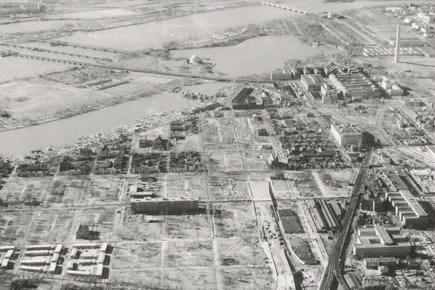
William Zeckendorf and I.M. Pei stepped into this void to head the redevelopment effort.
The two, at least on the surface, could not be more different. Zeckendorf was a brash, cigar chewing developer from New York, and Pei, a forward thinking architect from China. But their vision was the same.
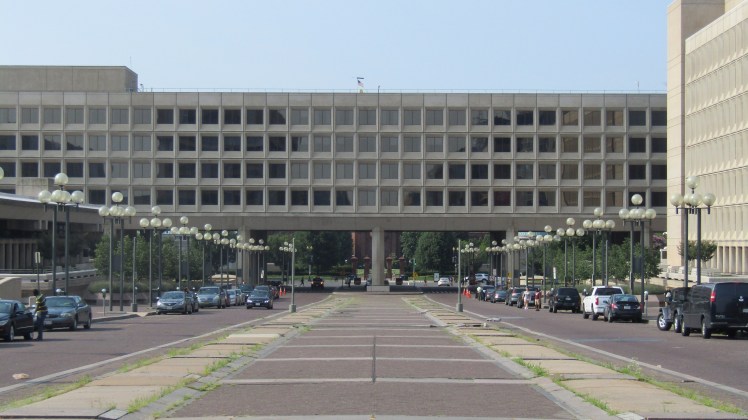
Pei envisioned blocks and blocks of his signature concrete bunkers, some housing office complexes, some cultural buildings such as theaters and museums. The whole complex would be tied together by a 400 foot wide south mall running from the Smithsonian Castle through Southwest DC and terminating on the waterfront. His plan was hailed as salvation for the city.
“This would be L’Enfant Plaza, a drawing card for the suburbanite who moved out into the country and rarely come back to central Washington and for thousands of visitors who now have little to do once they’ve tramped through the monuments and shaken hands with their Congressmen.”
Washington Post, 1954
Between 1959 and 1964, the size of the development shrunk down to a handful of office buildings and a hotel. Zeckendorf ran into financial difficulties and was forced to withdraw from the development. A group of investment bankers led by a retired Air Force general and descendants of John D Rockefeller took over the project, under the umbrella of L’Enfant Plaza Corp.
Despite the change in ownership and downsizing of the project as a whole, Pei’s vision lived on and in 1968, with only three buildings complete, L’Enfant Plaza opened. It was an instant though vanishingly temporary hit.
“Washington will here have its own Rockefeller Center–a busy beautiful agora, as the Greeks called it, where people will go not to shop and work and do purposeful things. It is a place where they’ll simply want to be.”
Washington Post, 1968
But despite its central location and high concepts designs, L’Enfant Plaza very much is not a place people simply want to be. It’s a stone desert in the middle of a bustling center. The type of place that lost tourist check their phones, hoping to find their way back to the mall. The type of place where everything closes at six because no one would willingly stay there after work.
And why?
Because the buildings are so ugly.
Places like L’Enfant Plaza happen when developers and architects’ artistic interests diverge drastically from common taste. When doing something different is confused with doing something creative. Like a modern art exhibit where the concept is so abstract and academic that only the art community enjoys it, the casual observer pretends to understand it, and the vast majority avoid it entirely.
That’s what L’Enfant Plaza and much of brutalism is: an imposing and unpopular piece of modern art that lives on only due to the fame of its creator rather than the merits of the creation.
 districtrecord.com